Breaking the joint distribution into simpler pieces
When two random variables are described together, we can either focus on one variable alone or ask what happens when information about the other variable is known.
p(x,y)
Marginalize →Condition →
Ignore YpX(x)
Know X = xp(y | x)
Marginalization removes information about another variable. Conditioning uses information about it.
A joint distribution tells us how X and Y vary together. What if we only care about one of them?
Joint density p(x,y). Collapse vertically across all Y values.
pX(x)
Press Marginalize to collapse the joint distribution.
Marginalization asks: what does one variable look like when we do not specify the other?
Ignoring information is not the same as using information
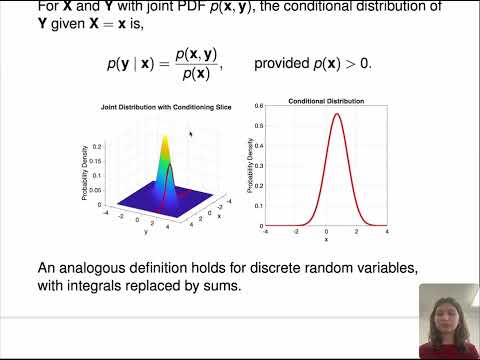
A marginal distribution averages over the other variable. A conditional distribution asks a different question: what changes once something is known?
Explore 02
What changes when we know the weather?
Imagine observations collected over 100 days. Let X be Weather, Sunny (S) or Rainy (R), and Y be Mood, Happy (H) or Sad (D).
Each central cell describes the probability of a pair of outcomes.
Joint distribution P(X,Y)
Happy
Sad
Total
Sunny
0.40
0.10
—
Rainy
0.20
0.30
—
Total
—
—
—
P(Y | X = S)
Happy80%
Sad20%
A conditional distribution is a slice of the joint distribution, renormalized to sum to one.
joint distribution→select a row→divide by the row total→conditional distribution
Two different questions
Marginal P(Y)
What is the distribution of mood overall?
Happy 60% · Sad 40%
Conditional P(Y | X = S)
What is the distribution of mood among sunny days?
Happy 80% · Sad 20%
The marginal distribution averages over weather. The conditional distribution uses information about weather.
KEY TAKEAWAY
A joint distribution contains multiple views of the same probabilistic system. Marginalization isolates one variable by summing or integrating over the others. Conditioning updates the distribution using information that is known.
 ▶
▶