 ▶
▶K-means loss
The objective sums squared distances from every point to its assigned centroid.
Using loss reduction without over-partitioning
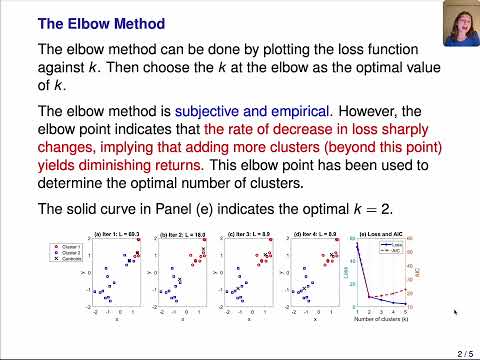
Increasing k always lowers k-means loss, so the smallest loss alone cannot choose the model. The elbow method looks for the point where extra clusters yield diminishing returns.
The essential idea: choose k near the bend in the loss curve, not at its absolute minimum.
The objective sums squared distances from every point to its assigned centroid.
Look for a sharp change in the rate at which loss decreases.
Move across candidate values of k and compare the selected partition with its loss curve.
The elbow method chooses a parsimonious number of clusters where additional complexity buys little improvement.